
Blog
Why Are Dogs Afraid of Men? The Science Behind "The Vibe"
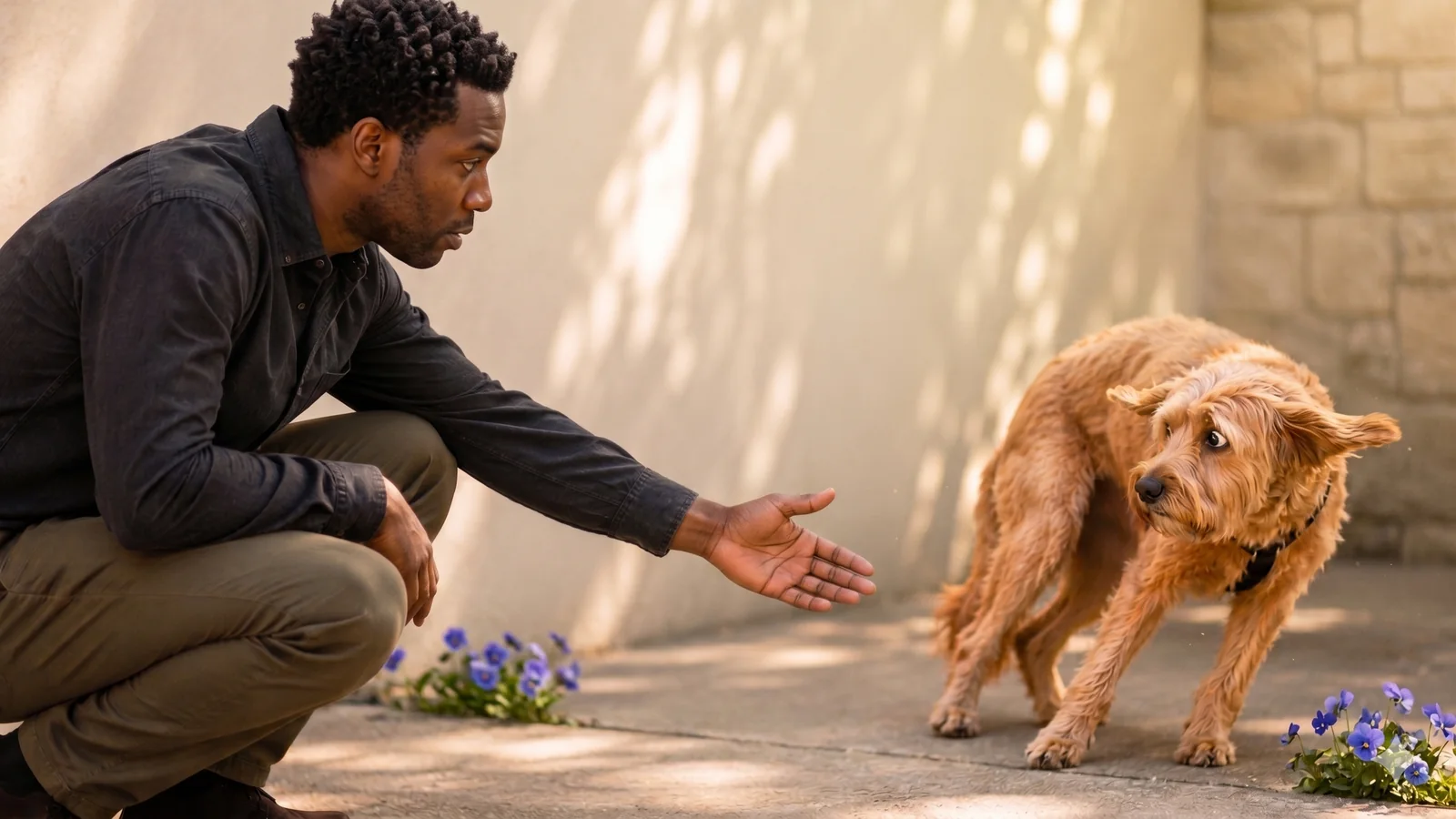
If you've got a shy or nervous dog, there's a good chance they're more uneasy around men than women. Walk into a room full of women with that dog, and they're relaxed. Walk into a room full of men, and suddenly they're glued to your side, tail tucked, scanning the exits. Why?
Most people jump straight to one explanation: a man must have done something to this dog. And look, sometimes that's true. But if that were the whole story, we'd be living in a pretty dark world, because the number of dogs who react this way to men is way higher than the number of dogs who've actually been mistreated by one. Something else is going on, and it's bigger than any one bad experience.
Masculine Energy vs. Feminine Energy
Here's an exercise I give people all the time. Picture yourself walking into a room full of fifty women. What does that feel like? For most people, it's easy. Calm. The energy is light.
Now picture that same room, but it's fifty men. Same room, same number of people, completely different feeling. More intense. More charged. You can feel it before anyone says a word.
That shift is real, and dogs feel it too, often more than we do. Men and women carry different energy. Not better, not worse, just different. And for a shy, nervous, or unstable dog, that more intense, assertive energy reads as something to be careful around. It's all about the vibe.
The Science Behind the Vibe
For a long time, "it's the vibe" was about as specific as I could get. Now there's actual research that breaks down what that vibe is made of.
Movement. A study published in Current Biology found that men and women move differently, and that this difference changes how people perceive it. When researchers showed people figures represented only by points of light at the joints, masculine-looking movement was perceived as coming toward the viewer, while feminine-looking movement was perceived as moving away, even when neither figure was actually approaching. Patricia McConnell, one of the most respected animal behaviorists out there, connected this directly to dogs: fearful dogs are always more afraid of something moving toward them than something moving away. If male movement reads as "coming at you" almost universally, that's a huge piece of the puzzle.
Voice. In dog language, pitch carries meaning. A low-pitched sound usually signals a threat (think growling), while a high-pitched sound signals fear, excitement, or play. Dogs are more likely to retreat from a low, stern tone and respond better to higher-pitched voices. Men's voices are, on average, lower. A perfectly friendly "hey buddy" in a deep voice can land in the same category as a warning growl to a dog who's already on edge.
Scent. A dog's nose has around 300 million scent receptors, compared to our roughly 6 million. That kind of nose can pick up chemical differences tied to hormones, including testosterone. Dogs identify gender through scent more than anything else. Whatever "maleness" smells like to a dog, they can smell it from across the room, long before a man says a word or makes a move.
Body language. On top of all that, men statistically tend to use more direct eye contact, faster movements, and more confident, square-on postures when approaching a dog. To a dog who already feels uneasy, all of that reads as pressure, maybe even as a challenge.
Stack movement, voice, scent, and body language on top of each other, and you've got a pretty loaded combination, even from the kindest man in the world.
It's Not About Abuse
I've met plenty of dogs raised in homes with loving, gentle men who still tense up the moment a strange man walks in. That's the part that doesn't fit the "someone must have hurt them" theory. The fear shows up even when there's no bad history to point to.
And the research backs this up. Behaviorists who've spent decades working with fearful dogs will tell you the same thing: almost all shy dogs are more afraid of men than women, even when the men in their lives have been nothing but kind. This isn't a story about what happened to your dog. It's about what your dog is built to notice.
How to Make Your Dog Comfortable Around Men
So what do you actually do about it? There are three rules I give every client with a scared or anxious dog, and once you understand the science above, they make a lot more sense.
- Don't look. This is the most important one. Eye contact is social pressure to a dog, full stop. Combine a direct stare with movement that already reads as "approaching," and you've stacked two intimidating signals on top of each other. Anyone meeting a nervous dog should use peripheral vision instead: glance, don't lock on.
- Don't talk. Especially not in a deep, enthusiastic voice aimed right at the dog. Remember, low pitch reads as threat in dog language. The friendliest "hi there, buddy!" can land like a warning.
- Don't pet. Not yet. Touching a dog who hasn't decided you're safe yet, especially from above, just adds another layer of pressure on top of everything else.
Instead, have everyone, including you, act like the dog isn't there. Let the dog sniff the new person from a distance, on their own time. That nose is doing more work than your words ever could. Once the dog has had time to get comfortable, they'll often come over on their own to sniff some clothes, maybe even lick a hand. That lick isn't affection, not yet. It's your dog's nose going to work on a deeper level. Dogs have a second scent system, separate from the one that reads the air, built specifically for sampling chemical information that only comes through direct contact. Licking is how they pull that information in. They're not greeting the person. They're reading them.
Even once that happens, don't rush straight to petting. Give the dog time to actually finish that investigation, and look for more than just "they stopped sniffing." You want to see a relaxed, loose body, and genuine friendly engagement, leaning in, soft eyes, maybe nudging for more. That combination, investigation finished and the dog actively friendly, is the real green light.
When you do get to the petting stage, two things matter.
Make sure the dog is calm first. If a dog is anxious or overly wound up and gets affection anyway, you're rewarding that state. And if your dog is nervous and you let someone keep touching them anyway, your dog learns something uncomfortable: that you won't step in. That's a real hit to the trust between you.
Pet from underneath, never over the head. In dog language, anything coming down over the body or head reads as intimidating, even aggressive. Petting under the chin or on the chest keeps things calm.
And finally, be firm with people. Not every person is going to get this on the first try, especially if it's not something they're used to. That's fine. It's your job to speak up. Your dog needs you to be a confident, secure leader in these moments, so they don't have to handle it themselves.
Common Questions
Why is my dog afraid of men?
It usually is not abuse. Men and women carry different energy, and dogs read it. Men tend to move differently, speak at a lower pitch, and carry different hormonal scent. Low pitch reads as threat in dog language. For a shy or unstable dog, that combination is a lot to process.
Does a dog being afraid of men mean it was abused?
Sometimes, but far less often than people assume. If abuse explained every case, we would be living in a much darker world than we actually are. The more common explanation is energy, movement, voice pitch, and scent, none of which require anyone to have hurt the dog.
Can dogs smell the difference between men and women?
Yes. A dog's nose carries roughly 300 million scent receptors against our six million. That is enough to detect chemical differences tied to hormones, including testosterone. Your dog is picking up information about a person before that person says a word.
Why does my dog react to a man's voice?
In dog language, pitch carries meaning. Low-pitched sound reads as threat, the way a growl does. Higher pitch reads as fear, excitement, or play. A man's naturally lower voice can land as threatening to a nervous dog even when the man is being gentle.
How do I help my dog get comfortable around men?
Do not force the introduction. Let the dog approach on their own timing, keep the man's energy calm and his movement unhurried, and have him avoid direct eye contact and reaching. The goal is letting the dog gather information without pressure.
The Bottom Line
Your dog's fear of men was never really about you, or even necessarily about men. It's about energy, movement, voice, and scent, all stacking up into something a sensitive dog can feel before any of us even notice it. Once you see it for what it is, you can actually do something about it. And that's a much better place to start than "someone must have hurt them."
Back to Blog