
Blog
Fear's Effect on Dogs: Why It Happens and How to Help
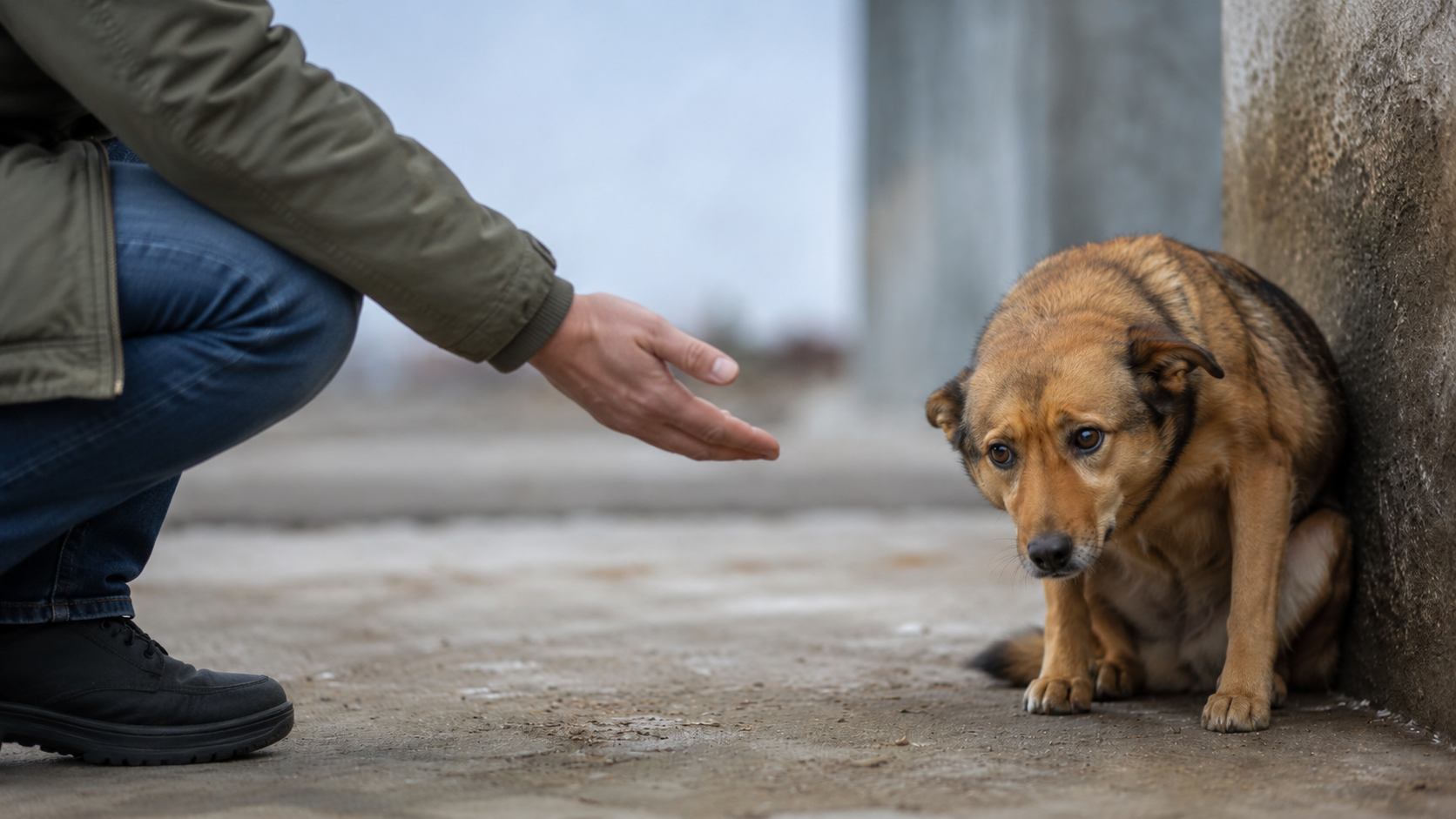
Every dog walks into your life carrying a story. Some of those stories are good. Some aren't. And when a dog is scared, really scared, the kind where they freeze, bolt, or snap, that's not "bad behavior." That's the story talking.
I get asked one question more than almost any other: "Why is my dog like this?" Before we get into how to help a fearful dog, we need to understand where the fear actually comes from. That's where Dogenality℠ starts.
It Starts With Their Story, Not Yours
A dog's personality and a dog's fear are both built from four things working together. Once you understand these four, a fearful dog stops feeling like a mystery and starts feeling like a puzzle you can actually solve.
- Innate Characteristics (Genetics) Some dogs come into this world more cautious than others. It's wired in, the same way some people are naturally more easygoing and others startle at every loud noise. This isn't a flaw. It's just the foundation they're building on.
- Learned Behavior This is what life has already taught them. A dog who got hurt, cornered, yelled at, or surprised in a certain situation learns from it, fast. Dogs are experiential learners. They don't need ten repetitions to learn something scares them. Sometimes one is plenty.
- Environment What's happening around your dog right now matters just as much as what happened in the past. A new house, a chaotic household, construction next door, a recent move: all of it shapes how "safe" the world feels on any given day.
- Willingness This one is innate too, but it's its own piece of the puzzle: how much your dog actually cares about pleasing you. Some dogs are wired for it. They're tuned into your reactions and genuinely motivated by your approval. Other dogs aren't. They're not being stubborn or difficult; making you happy just isn't what drives them.
This matters when it comes to fear, because it changes how your dog responds to your guidance. A dog with high willingness might push through something scary because they want to do right by you, which can look like progress on the surface, without the fear underneath actually going anywhere. A dog with low willingness won't push through anything just because you'd like them to. Their decisions are based on their own read of the situation, not on your approval. Either way, you can't praise or motivate your way around fear. You have to address what's actually causing it.
Here's the part worth holding onto, though: that starting point isn't where it has to stay. As trust grows between you and your dog, willingness can grow with it. The stronger your rapport becomes, and the more your dog learns that you're the one who steps up and handles things, the more their willingness toward you can rise. It isn't that they suddenly start caring about your approval out of nowhere. It's that they feel safer with you, and a dog who feels safe has a lot more room to say yes.
Put those four together and you get a real, specific reason for the fear in front of you: not a label, an explanation.
What's Actually Happening Inside Their Body
Here's the part most people never get told: fear isn't just "in their head." It's chemical, and it runs on two hormones working together: adrenaline and cortisol.
Adrenaline hits first, and it hits fast. The instant something happens, adrenaline floods the body: heart rate spikes, senses sharpen, everything ramps up in a heartbeat. Here's the part I talk about constantly: adrenaline doesn't know the difference between excited and afraid. It doesn't pick the emotion, it just turns up whatever's already there. The same rush that turns "you're home!" into a full-body, can't-contain-myself greeting is the same rush that can turn "I'm a little unsure about this" into "I am completely overwhelmed" in about two seconds. Adrenaline is the volume knob, not the channel.
Right behind it comes cortisol, the slower-burning stress hormone. It's the same hormone your body releases when you're cut off in traffic or startled awake. Cortisol is what fuels the freeze, flight, or fight response, and unlike adrenaline, it doesn't switch off the second the scary thing is gone. It can take hours, sometimes much longer, for a dog's body to fully come back down to baseline. That's why a dog who had one bad encounter in the morning might seem "more reactive" than usual later that same day. They're not being dramatic. They're still chemically wound up from earlier, and it doesn't take much adrenaline on top of that lingering cortisol to push them over the edge again. In the dog world, we call this trigger stacking, and it's one of the most overlooked reasons fearful dogs seem unpredictable.
Understanding this changes everything. A fearful dog isn't choosing to overreact. Their body is running on adrenaline and cortisol, and that combination takes time to reset.
Your Job: Be the Protector, Not the Problem
This is where the pet parent comes in. Being a parent already covers it: guiding them, setting the rules, stepping in when they need you to, and keeping them safe. A scared dog isn't looking for someone to negotiate with. They're looking for someone who's got this.
Every interaction you have with your dog is either making a deposit into that trust account or making a withdrawal. When you advocate for your dog, when you step between them and whatever is making them nervous, when you don't force an interaction they're not ready for, you're showing them, over and over: I've got this. You don't have to.
That message is everything. A dog who trusts that their parent will handle the scary stuff doesn't have to handle it themselves. And a dog who feels like they're on their own? That's the dog who feels like they have to make every decision, including the decision to bite.
Resocializing vs. Desensitizing: There's a Big Difference
A lot of advice out there is built around desensitization: expose the dog to the scary thing, over and over, until they stop reacting. The problem is that "stopped reacting" isn't the same as "feels okay about it." Sometimes it just means the dog has given up trying to communicate that something is wrong.
What I focus on instead is resocialization: helping a dog build a new relationship with the thing that scares them. Instead of grinding down their reaction, we change the story. We give them a different experience with that trigger so their brain has new information to work with: this thing doesn't always mean what I thought it meant.
This is where games like Parking Spot, Calm & Relax, and the Bubble Game earn their keep. They give your dog a way to be near something unfamiliar while you're actively managing the space, so instead of bracing for impact, your dog gets to practice feeling okay. Repetition matters here too. What you rehearse, you master. The goal isn't a dog who tolerates the world. It's a dog who sees it differently.
The Most Common Fear of All: New People
If there's one fear I see more than any other, it's fear of unfamiliar people. New faces, new voices, new energy walking through the door: for a lot of dogs, that's the scariest thing in their world.
(We're going to dig into one specific version of this, fear of men, in its own article, because it deserves a closer look. But the basics below apply across the board.)
How to Greet a Fearful Dog the Right Way
This part hasn't changed, because it works. If you remember nothing else, remember this:
Don't reach for the dog. It's one of the most human instincts there is, and one of the fastest ways to get bitten. Putting your hand toward a fearful dog's face is putting physical and social pressure on them, in their space, on their terms. Ask yourself: if a stranger reached for your face the second they met you, would that feel friendly? It wouldn't. It would feel like a threat.
Let the dog come to you. If the dog hesitates, backs away, or just doesn't move toward you, that's information. They're telling you they're not ready. Don't pet. Don't reach. Just give it time.
Let them use their nose. If a dog approaches to sniff you, that's a win, but it's not an invitation to touch. Some dogs need to gather information before they're ready for contact, the same way you wouldn't hand a shy kid over to a stranger for a hug the moment they walked in the room.
Pay attention before it becomes a bite. A dog rarely goes from "fine" to "biting" with no warning in between. Long before that happens, they're communicating: backing up, stiffening, looking away, trying to create distance. If your dog could talk, they'd be saying "this is too much, help me out here." A bite is often the last resort after every quieter signal got missed. And when it happens, it's almost always the dog who pays the price.
The Bottom Line
Fear in dogs isn't a mystery, and it isn't a character flaw. It's the result of who they are, what they've lived through, what's happening around them, and how much they have left to give on any given day, all running through a body that's chemically built to react first and think later.
Your job isn't to push through that. It's to understand it, protect your dog while they're in it, and give them new experiences that rewrite the story. That's the whole game: balance the human, rehab the dog, and you get a happy life, for both of you.
Back to Blog