
Blog
Laser Pointer Syndrome in Dogs: I Called This Years Ago, and the Science Finally Caught Up
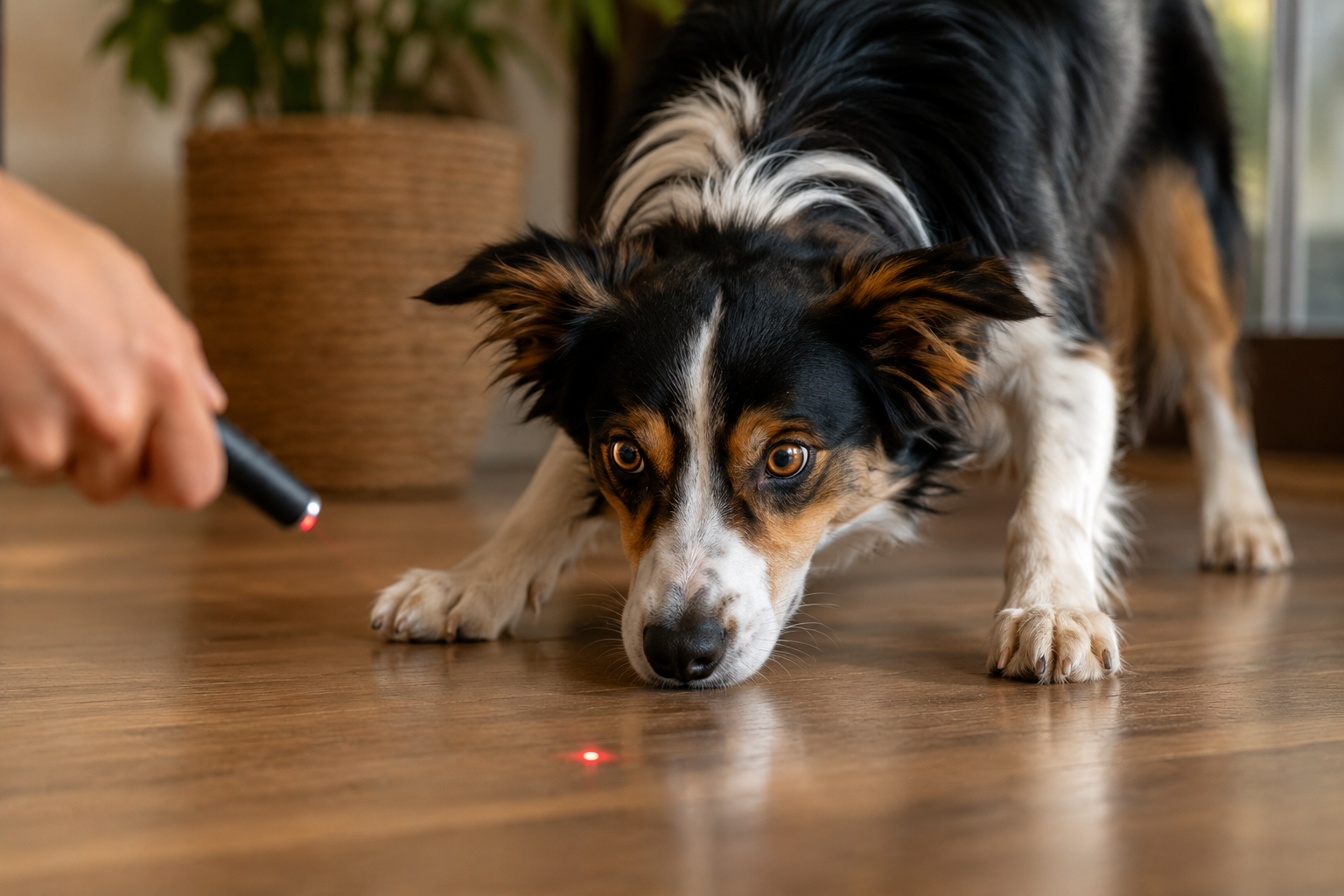
Laser pointers look like the easiest win in the world. Five minutes of your dog zooming around the living room chasing a little red dot, and you barely had to get off the couch. We've all seen the videos. A lot of us have done it ourselves.
Here's the problem with that little red dot: it's a promise your dog can never collect on.
What I Was Seeing Years Ago
Back in May of 2018, long before I had any research to point to, I wrote about this because I kept seeing the same thing show up in client after client. Here's some of what I actually wrote back then, word for word:
After playing like this, dogs can easily become obsessed over lights, reflections, and even shadows. This type of behavior is based on frustration, and it also seems to change the neurology of the brain. Dogs become obsessed over reflections. They may chase everything from your watch on the wall to light shining through glass doors. They are constantly on the lookout for anything that is similarly reflective. The constant watchfulness becomes a neurotic and obsessive behavior, and a very unhappy way of being. I have also found that it is difficult, if not impossible, to reverse. Something gets switched on in the brain and becomes perpetual.
No studies. No MRI scans. No citations. Just years of walking into homes and watching it happen, over and over.
One consultation has stuck with me ever since. Five dogs, one household, and the family had been using a laser pointer as their go-to way to "exercise the pack." Four of the five dogs were already showing the syndrome. Four out of five.
Turns Out, I Was Right
Here's what's wild to me, reading my own words again all these years later: pretty much everything I wrote based purely on what I was watching in real homes lines up with what researchers have since found in labs, with their names attached.
Take "something gets switched on in the brain." In 2013, Dr. Niwako Ogata and Dr. Nicholas Dodman at Tufts University's Cummings School of Veterinary Medicine, working with Dr. Marc Kaufman at Harvard Medical School's McLean Hospital, used MRI to compare the brains of dogs with canine compulsive disorder, the dog version of OCD, to healthy dogs. Published in the journal Progress in Neuropsychopharmacology & Biological Psychiatry, their results showed real structural differences: changes in brain volume, and differences in the regions tied to anxiety and repetitive behavior. Those differences look a lot like what shows up in human brains with OCD. I didn't know any of that when I wrote "something gets switched on." I just knew it looked permanent, because in the dogs I was seeing, it was.
Then there's why it happens in the first place. Every dog has a built-in sequence for hunting: spot it, stalk it, chase it, catch it. A laser pointer lets a dog do the first three and then rips the fourth one away. Every single time. There's no catch. Ever. For a dog with a strong drive to finish that sequence, that's not a fun game, it's an open loop that never closes. And the more times it opens without closing, the more the brain seems to get stuck looking for it.
That also explains the part I noticed about high-energy, high-prey-drive dogs being more susceptible. Back in 2010, Dr. Dodman teamed up with Dr. Elinor Karlsson and Dr. Kerstin Lindblad-Toh at the Broad Institute of MIT and Harvard, along with Dr. Edward Ginns at UMass Medical School, and published a study in Molecular Psychiatry identifying an actual gene on canine chromosome 7 linked to compulsive disorder risk. The AKC Canine Health Foundation, reporting on that research, lists German Shepherds, Dobermans, Border Collies, Jack Russell Terriers, Great Danes, and Retrievers among the breeds most at risk. Every one of those is a breed bred for an intense version of that hunting sequence. That's not a coincidence. The stronger the drive to finish the sequence, the worse it is to never let them finish it.
To be fair, none of these studies set out to prove that laser pointers specifically cause this. Nobody ran an experiment handing a group of puppies laser pointers to see what happens, and nobody should, that would be cruel. What these studies did establish, with real names and real universities behind them, is that canine compulsive disorder is a measurable, brain-based, genetically-linked condition, and that it shows up most in exactly the breeds people love to hand a laser pointer to.
The laser-pointer connection itself comes from what I had: behaviorists across the board, independently, watching the same pattern unfold in real dogs for years. One behaviorist who's worked with dozens of clients on exactly this kind of obsessive light and shadow chasing found something striking: every single one of those dogs, without exception, had a laser pointer in their history as a puppy. When she brought that pattern to Dr. Dodman directly, he told her he'd seen the exact same thing across his own decades in practice. That's basically my five-dog story, told by someone else, in a different practice, years apart. At some point that stops being a coincidence and starts being data too.
Laser Pointer Alternatives
So what do you do instead? My answer hasn't changed: walking, running, hiking. Get outside, let your dog's body and nose do what they're built to do, and you'll probably feel better too.
But there's more to it than just burning energy. The real key is giving your dog outlets that actually use the traits they were bred for, the ones that let them finish the sequence instead of leaving it hanging open.
Nose work lets a scent-driven dog search and find, with a real end point. Fetch lets a dog chase something and actually bring it back. Frisbee gives a high-drive dog something to track, jump for, and catch in their mouth. Water retrieving gives water-loving breeds a job with a beginning, a middle, and an end.
The common thread in all of these: there's a catch. There's a finish. Your dog's brain gets to close the loop, every time, instead of being left open and searching.
The Bottom Line
I still don't have a study with my name on it. What I have is years of watching this play out in real homes, and now, a growing body of research that backs up what I was seeing the whole time. If your dog is staring at shadows, chasing reflections, or can't seem to settle once that fixation kicks in, it's not quirky and it's not something to laugh off. Put the laser pointer away, and give that drive somewhere real to go. Your dog will thank you, even if they don't have the words for it.
Back to Blog