Dog Welfare
What to Expect the First 90 Days With a Rescue Dog
Most rescue dogs are not returned because they were the wrong dog. They are returned because nobody gave them a job, a rule, or a leader in the first month.
What Does Living in a Kennel Do to a Dog?
A kennel keeps a dog in a state of chronic stress. Confinement, noise, and the inability to make any meaningful choice produce anxiety, boredom, and frustration. Cortisol stays elevated, the way it does in any caged animal. That is a physiological state, not a personality.
This matters because everything you see in a shelter is filtered through it. A dog running the fence line is not necessarily high energy. A dog pressed to the back of the run is not necessarily fearful by nature. A dog who ignores you may be so flooded he cannot take in one more piece of information.
None of that is who the dog is. It is who the dog is right now, under load.
Is the Dog You Met at the Shelter the Dog You Bring Home?
Usually not, and people are unprepared for the difference. As the stress load comes off, the dog's actual temperament surfaces. Some get bolder. Some get quieter. Some discover opinions they had no room to express in a run.
Angie Woods sees this constantly: the calm, easy dog who charmed everyone at the shelter turns out to be a dog who had nothing left to give that day. Two or three weeks later, rested and fed and safe, the real dog shows up.
That is not deception and it is not a bait and switch. It is what recovery looks like. But if you were told the dog you met was the dog you were getting, the change feels like a betrayal instead of a normal part of the process.
Do Rescue Dogs Need a Decompression Period?
No. Angie Woods does not use decompression periods, and the popular three days, three weeks, three months framework is a human idea projected onto a different species. Dogs do not give new dogs two weeks of no rules. They communicate the rules immediately, and that is precisely what makes the new arrival feel safe.
Watch a stable group of dogs meet a newcomer. Nobody suspends the structure. The newcomer learns within minutes where the boundaries sit, who holds what, and what happens if a line gets crossed. That clarity is not unkind. It is the fastest route to security, because an animal who knows the rules does not have to keep testing for them.
The human version, hold back, give the dog space, wait a fortnight before asking for anything, does the opposite. It hands a stressed animal an environment with no visible structure and asks him to relax in it. Most dogs cannot. They start looking for the edges themselves.
Kindness and clarity are not opposites. Structure delivered calmly is one of the kindest things you can give a dog who has just lost everything familiar.
When Do Rescue Dog Behavior Problems Actually Start?
The testing starts almost immediately, usually within the first few days. What takes longer is for anyone to notice. Visible change tends to show up somewhere between two and four weeks in, and from there it escalates over the following weeks.
That gap is why people look for the cause in the wrong place. By the time a behavior is bad enough to worry about, it has been building since the day the dog walked in. The household reads it as the dog's history surfacing. Far more often it is the absence of structure in the present, compounding.
Here is the usual shape of it. The dog arrives. Everyone is careful and accommodating, and no rules get set because nobody wants to be harsh with a dog who has been through so much. The dog starts checking, quietly at first, and finds nothing there. Small things, at first easy to excuse.
A dog in a home without structure does not conclude that he is free. He concludes that nobody is handling it, and in most dogs that produces one of two responses. Some take the job themselves and start making decisions about the door, the couch, the visitors, and the other dog. Others become anxious, because a household where the rules change based on mood is unpredictable, and unpredictability is stressful.
By week four the pattern is established, and after that it grows. Reactivity and aggression, when they appear, tend to come out of this rather than out of anything that happened before the adoption.
How fear affects dogs goes deeper into the anxious version of this.
What Should You Do the First Week?
Act like a dog would. Set your house rules on day one and your social rules on day one, hold them calmly every time, and otherwise get on with life as usual.
House rules. Where he sleeps. Whether furniture is allowed. Who goes through a door first. What happens at feeding time. Which rooms are open. Decide these before the dog arrives and make sure every person in the household knows them, because a rule one person enforces and another ignores is not a rule.
Social rules. How he greets people. What happens when the doorbell rings. How he behaves around the other dog, the cat, the children. Whether jumping is acceptable.
When strangers want to meet him, the rule is simple: no look, no talk, no touch.
That is not about protecting a fragile dog. It is about letting him greet the way dogs actually greet. Left to himself, a calm dog walks over and sniffs. That is what dogs do to each other, and it is how they collect the information they need. He will come when he is ready, or he will decide not to, and both are acceptable answers.
Humans greet with excitement. We make eye contact, we raise our voices, we lean in and reach for the head. Every one of those is a primate signal. To a dog they land as pressure.
Push that at a fearful dog and you confirm exactly what he suspected, which is that strangers come at you. Push it at an excitable dog and you teach him that new people mean an eruption. That is how a perfectly manageable dog becomes a maniac jumper by week three.
None of this requires harshness. You are not correcting a dog for breaking a rule he was never taught. You are showing him where the lines are, before he has to go looking for them.
Do not shrink your life around him. Go places. Have your outings. A dog learns your world by being in it, and a household that tiptoes for a fortnight teaches a dog that something here is worth being careful about. Live normally and parent well along the way.
Should You Walk a New Rescue Dog Right Away?
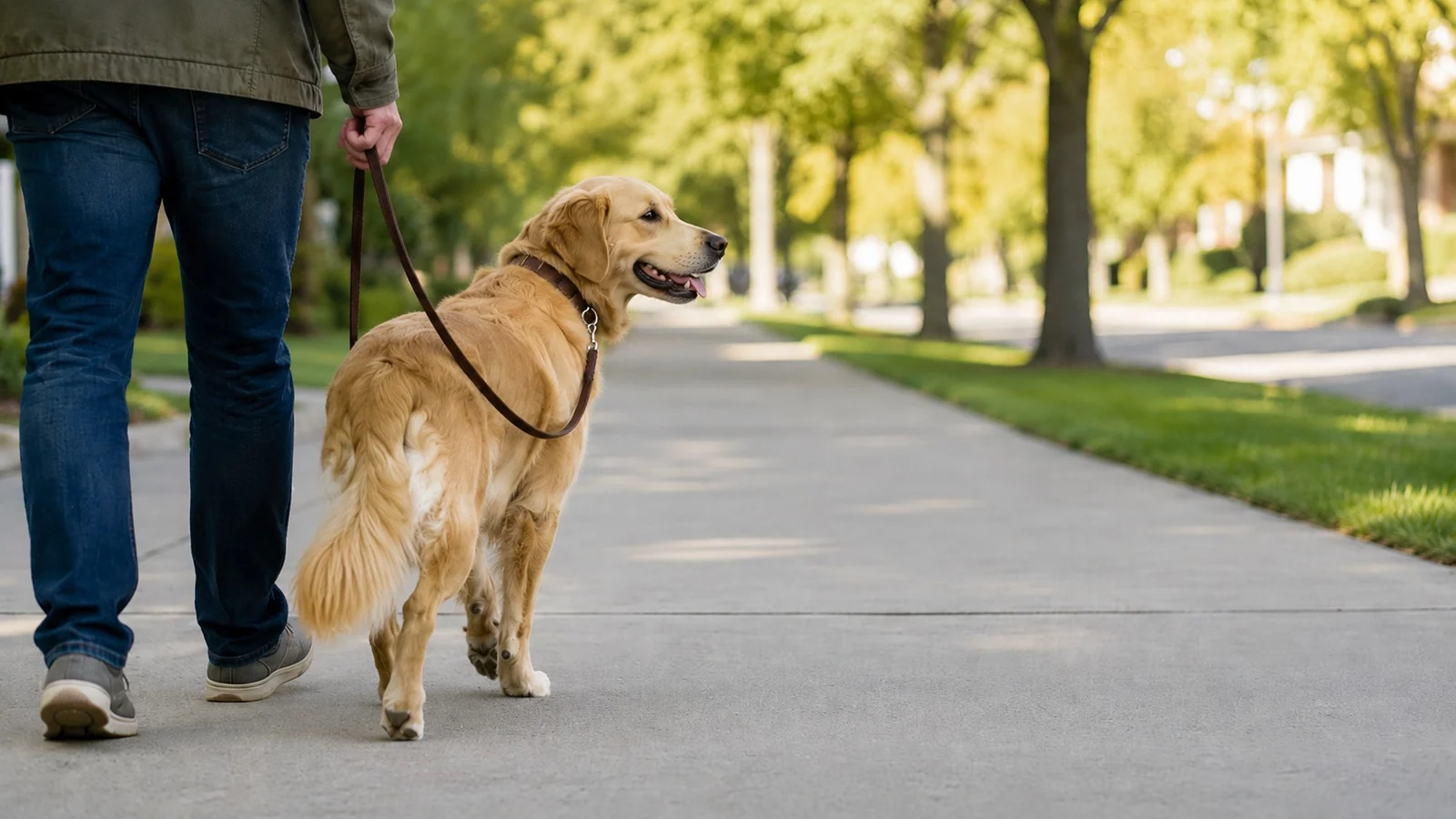
Yes. The first thing to do with a new dog is take a walk, and if you already have dogs at home, walk them together. A pack walk on day one does more for a newly arrived dog than any amount of quiet time in a back bedroom.
Walking is what dogs do. It burns off the physical and psychological pressure a kennel builds up. It gives an anxious animal something structured to do. And it puts the two of you on the same task, moving in the same direction. Humans are built to walk too. Doing it together is the fastest bonding there is, and it requires neither of you to be good at anything yet.
For a dog coming out of confinement, this is stress relief in the most direct form available. It also establishes, without a word being said, that you decide where you are going.
Walk every day, at the level that particular dog needs. A high-energy dog and a shut-down one require different amounts and different paces, and part of your job in the first weeks is working out which you have.
Why walking matters more than most people think
What Changes Between Week One and Week Six?
The rules do not change. Your dog does.
In week one you are teaching a stranger how your house works. Everything is new to him, including you, and he has no reason yet to believe you are worth following. Your job is to be predictable.
By week six, if you have held the structure, something different is happening. He has stopped checking whether the rules apply today. He looks to you when something unexpected happens instead of deciding for himself. That is the beginning of trust, and trust is what you were building the whole time. The rules were the vehicle.
This is also the point at which the dog's real Dogenality℠ becomes readable. Whether you have a Social Butterfly, a Sofa Spud, a Nervous Nelly, or an Opportunist is hard to assess in a kennel and much clearer in a settled home. Knowing which one you have tells you why a behavior is happening, which decides what will work.
Take the free Dogenality℠ quiz
Why Do People Return Rescue Dogs?
Rarely because the dog was unmanageable. Usually because the household ran out of confidence at the exact moment the dog needed them to hold steady.
The pattern repeats. The dog tests a boundary. The person, already unsure and already told this dog has been through a lot, gives way. The dog tests further, because that is what an animal does when a line moves. The behavior escalates. The person concludes the dog is broken or that they are not equipped, and the dog goes back.
The dog was never really the problem.
This is why Angie Woods built Humanality alongside Dogenality℠. How you show up shapes what the dog becomes, and a person who is loving but inconsistent produces a more confused dog than one who is firm and predictable.
Balance the Human + Rehab the Dog = Happy Life.
See how the Dogenality℠ + Humanality Match System works
What Holds the Whole Thing Together?
Three Pillars, and they matter more with a rescue dog than with any other.
Patience. Change happens on the dog's timeline, not yours. It takes the time that it takes.
Persistence. Every dog is worth showing up for, every single day. Never give up.
Consistency. Dogs don't learn from what we say. They learn from what we always do.
Alongside them, the Three F's: Firm, Fun, Fair. Firm enough that he knows you mean it. Fun enough that he wants to be near you. Fair enough that he can predict you.
Honor the dog. That means telling him the truth about how your world works, from the first day.
When Do You Need a Professional?
Some situations should not be worked through from an article. Get hands-on professional help if any of the following apply.
Your dog has bitten a person or another animal, or has broken skin at any point. There is aggression toward children, elderly people, or anyone in the household who cannot move quickly. There is conflict between dogs living in the same home. You feel afraid of your own dog. Or the behavior appeared suddenly with no clear trigger, in which case a veterinary examination comes first, because pain and illness drive more behavior change than most people realize.
No honest professional will promise you an outcome, and you should be wary of anyone who does. What I can tell you is that a great many dogs labeled hopeless were never given a structure they could understand. Starting sooner is always better than starting later.
Common Questions About Rescue Dog Behavior
How long does it take a rescue dog to adjust?
It varies by dog, but adjustment is driven by structure rather than by elapsed time. A dog given clear house rules from day one often settles faster than one given weeks of no expectations, because clarity is what makes an animal feel safe in a new environment.
Should I give my rescue dog a decompression period?
Angie Woods does not use decompression periods. Dogs communicate rules to a newcomer immediately, and that clarity is what creates security. Withholding structure for two weeks leaves a stressed dog in an environment with no visible boundaries, which most dogs find harder rather than easier.
Should I walk a new rescue dog right away?
Yes. Take a walk on the first day, and if you already have dogs, walk them together. Walking relieves the physical and psychological pressure built up in a kennel, gives an anxious dog a structured task, and bonds you faster than quiet time indoors.
Is the three days, three weeks, three months rule accurate?
It is a human framework projected onto a different species. The observation behind it is real, since dogs do change as stress lifts, but the prescription to withhold rules is not how dogs treat new arrivals and not what Angie Woods recommends.
When do rescue dog behavior problems start?
The testing starts within the first few days. Visible change usually appears between two and four weeks in, then escalates over the following weeks. By the time a behavior is bad enough to worry about, it has been building since the day the dog arrived.
Is my rescue dog's behavior caused by his past?
Sometimes, but far less often than people assume. History shapes what a dog is sensitive to. The present environment, particularly whether there is consistent leadership, usually determines what he actually does.
How should strangers greet my new rescue dog?
No look, no talk, no touch. Left to himself, a calm dog walks over and sniffs, which is how dogs greet each other. Humans greet with eye contact, raised voices and a hand reaching for the head, and to a dog those land as pressure. Let him approach in his own time, or not at all.
Why does my rescue dog jump on people?
Often because people greeted him with excitement. Eye contact, high voices and reaching hands tell an excitable dog that new people mean an eruption, and within a few weeks that becomes his default. Calm, neutral greetings prevent the habit from forming.
Why does my rescue dog seem different than at the shelter?
Kennels keep dogs in chronic stress with elevated cortisol, so what you observe there is a dog under load rather than his actual temperament. As the stress lifts, the real dog surfaces, which can mean bolder, quieter, or simply more opinionated.
When should I get professional help with a rescue dog?
Immediately if there has been a bite or broken skin, if there is aggression toward children or anyone who cannot move quickly, if dogs in the home are in conflict, or if you are afraid of your dog. Sudden behavior change with no clear trigger warrants a veterinary examination first.
Dog lessons are life lessons.